
Soldiers
In Time of War #3

In front of Corby Hall, the priests’ residence at Notre Dame, stands a statue of Fr. William Corby, C.S.C., with his right hand uplifted in blessing. The occasion was the second day of the Battle of Gettysburg as the Union soldiers for which he was chaplain prepared to enter the fight against the Confederate army. He was not simply blessing them. Knowing that most of the soldiers in the unit were Catholic and that their maneuvers left them no time for spiritual exercises, he was giving them a general absolution. Indeed, he made clear that even those soldiers—of either side—who repented of their sins could receive this absolution. What followed was a day of bitter bloodshed.
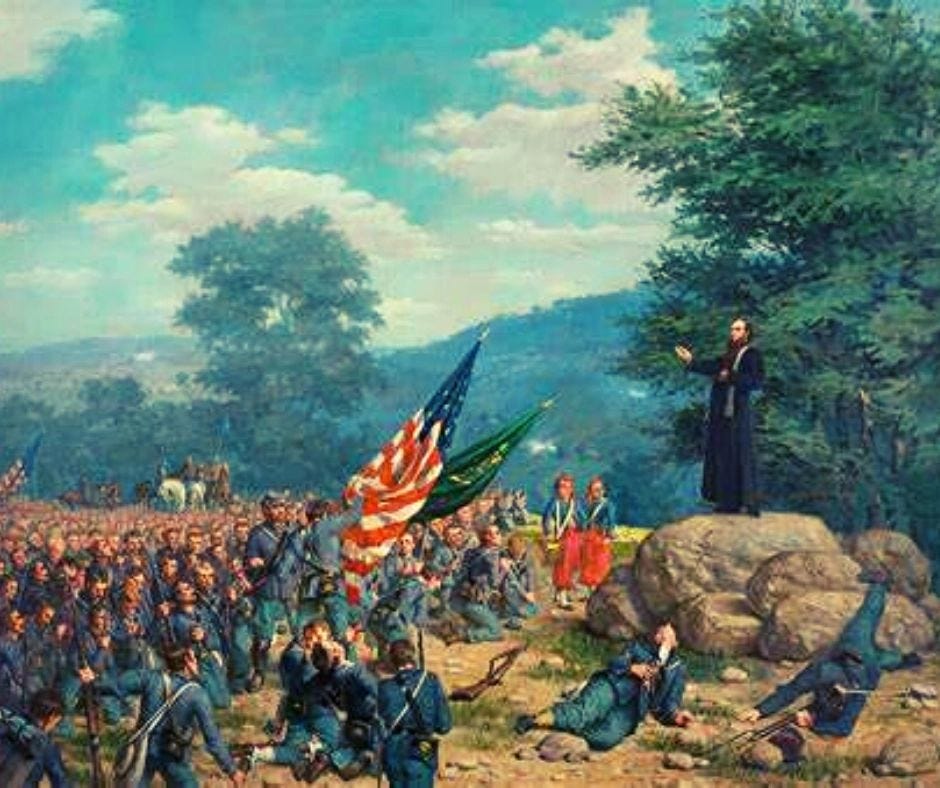
These soldiers were praying not for victory but for the salvation of their own souls. They asked God’s forgiveness for their own sins and not for defeat of their enemies. These American soldiers did not pray that “every round find its mark against the enemies of righteousness and our great nation,” or for “overwhelming violence of action against those who deserve no mercy” to quote Pete Hegseth. American soldiers do not claim “God on our side” as did the Kaiser’s army in World War I. Other nations are not like this. Solzhenitsyn tells us how Russia brutalizes her trainees in their training so that they will in turn brutalize their enemies.
We should look at the soldiers[*] and what war means for them, in particular for the American soldier. If there is an ideal candidate for an American fighting soldier—I have this from a couple of field grade officers during the Vietnam War era—he is the “good ol’ boy” from the south. S. was a good ol’ boy in our barracks. He was happy about his assignment to serve as an infantryman in Vietnam, carrying his rifle into the jungle with his buddies. Everything changed for him in his first firefight with the Viet Cong. The soldier next to him was killed, and he had to fight hard to avoid the same fate. From then on, war was not fun. The V.C. killed his buddy and wanted to kill him. He was angry and scared. And he showed himself a good soldier with leadership skills. He was promoted to sergeant.
After the attacks of 9/11, some young people volunteered to for military service, just as after the attack on Pearl Harbor, many enlisted. Patriotism is one motive for joining the armed services, but there are others—a job after high school, saving for college, an honorable career with good benefits. I was drafted in 1968, and today many who joined the National Guard to serve their local communities during natural disasters and civil disturbances find themselves serving abroad like regular Army troops. What motivates these people to fight? One answer, according to an officer who knows, is that it doesn’t matter what they want to do. In a war zone, a soldier is quickly motivated to fight.
Soldiering is impersonal. The recruit arrives for training, and he is soon taken to the barber, who shaves his head. He lines up in formation, directly next to his mate on the right. He learns to obey promptly. “Right face!” “Forward march!” “Present arms!” and so on. The drill sergeants insist on exact obedience and for good reason. Orders must be obeyed or soldiers will die—either you or your buddy. Obedience is of fundamental importance. You do not question your orders. The private does not know what the strategic situation is. The army (or navy or air force) must function as a unit, if it to function at all. If the soldier thinks an order is wrong, then he may express his concerns to his superior officers up the chain of command. But his responsibility is to obey. It can happen—and it has—that a command is immoral, a violation of human rights and the laws of war. Soldiers are made aware of this, and JAG (Judge Advocate General) officers are responsible to ensure that soldiers do not commit atrocities. And it had happened in Vietnam that some soldiers simply refused to violate civilians when ordered and suffered no consequences.
We read much lately about the principles of just war. Important as these are, they have little to so with soldiers. Although they do the fighting, soldiers have nothing to say about whom to fight and for what cause. Soldiers are sent to the front—or the jungle or the desert—where they must fight and often die. Sergeant S. was always a happy sort of guy, a good ol’ boy, but late one evening when he had drunk an extra couple or three beers more than was wise, he got quiet and reflective. He told us about leading a patrol in Vietnamese jungles. They were tracking a small detachment of Viet Cong guerillas. The challenge is to avoid losing track of the enemy, because they might use the cover of the jungle to evade and then ambush your own unit. It was tense, dangerous work. Sergeant S. was a good soldier and led his men well. Having briefly lost track of their foe, they came to a river, where they saw a covered raft floating away with their enemy. Or so they thought. Sergeant S. ordered his men to open fire. Their bullets tore apart the raft. Then they saw the bodies of the children and the women escorting them. When he told the story Seargeant S. was certainly not boasting. In fact, he needed some alcoholic lubrication to loosen his tongue to share this in the barracks. He and his men had inadvertently committed an atrocity. They did not want to. They thought they were firing upon an enemy. By mistake, they killed women and children.
Veterans of combat often return home with PTSD (post-traumatic stress disorder). Even with those closest to them they are reluctant to talk about their experiences. An acquaintance who had survived the Battle of the Bulge in 1944 would not talk about that battle, just like those today who fought in Fallujah. It is not only that their lives were constantly in danger, but that they too had killed other human beings. It is not natural to kill other people. We are not made for that. A person has to be conditioned to kill other people, and that conditioning comes with war. In my Basic Training we were not taught to kill the enemy. We were warned that if we failed to learn this or that lesson from the Drill Sergeant, then “Charlie’s gonna kill you.” (Charlie was the Army nickname for our enemy.) War is unnatural. Soldiers are called on deliberately to kill other people. Therefore, when the war is over, they too are harmed.
Going to war is a grievous decision, one that profoundly affects not only the enemy but also the nations own soldiers. They have to suppress what is best in them, their individual personhood and even their conscience. It may be necessary, of course, when the country is endangered, to save the homeland from an invader. This is the situation of Ukraine today. But war is always a tragedy. Even the most glorious victory leaves behind the crippled among the victors. Soldiers almost always lose.
[*] By “soldiers” I also refer to sailors, airmen, and even (if they will not be offended) Marines.
Turning to another topic
Just last month my latest book, Not Reliable Guides came out. It is a critique of covenant communities that arose in the charismatic renewal in the 1970’s. In this work I analyses their flaws and the dangers such groups constitute. In the book I reflect too on contemporary issues concerning intensely committed group and their understanding of men and women and of the nature of marriage. You can find out more here.